As He is Holy: Rev. Pete Mace
For the last few weeks, I have been praying through the first chapter of 1 Peter. Most Christian pastoral gurus would say it’s bad practice to use your personal prayer life for preaching fodder, but the realities of ministry and best advice don’t always align, so here we are.
After opening his letter to the churches scattered throughout what is now modern-day Turkey, Peter goes on to remind them of the all-surpassing worth of their salvation in Jesus Christ. More than gold, more than the sufferings and trials they may be going through, the matters of salvation are something even angels long to look into.
I’m giving all this by way of context, because what I really want to focus on is what comes next, and despite my earlier willingness to commit a pastoral faux pas, it’s still bad exegesis to start with a passage that begins with “therefore”. Because Peter starts in verse 13 with “therefore” (a.k.a. “because of this”) and goes on:
‘…with minds that are alert and fully sober, set your hope on the grace to be brought to you when Jesus Christ is revealed at his coming. As obedient children, do not conform to the evil desires you had when you lived in ignorance. But just as he who called you is holy, so be holy in all you do; for it is written: “Be holy, because I am holy.”’
And what continues to strike me each time is the way that Peter uses Jesus’s holiness. Be holy "as He who called you is holy.” Be holy because He who called you is holy. Jesus’s holiness is both the reason and the standard/example.
There’s something about the circular nature of it such that I can’t quite articulate why it matters so much to me. Jesus is holy, so I should be holy, as Jesus is holy, so I should be holy, as Jesus is holy, and on and on.
Maybe it’s because we do so few things, if any, simply for their own sake, and simply because they are what they are. Most of our lives are spent doing things for deeper reasons:
The pursuit of economic stability and feelings of safety through working profitable jobs, investing and saving, and owning a home.
The pursuit of social standing: we dress a certain way to fit in or dress another way to make a statement that we don’t fit in, thus trying to fit in with the non-conformers, joining certain clubs, groups, or societies to make connections, or presenting our lives in certain forms through forums such as social media.
We make friends and family in the pursuit of loving relationships, we exercise and eat right in the pursuit of heath/wellness.
And the list goes on and on.
And usually, if someone tells you they are doing a certain thing, behaving a certain way, or participating in certain practices and habits simply for its own sake, you can pretty quickly with some practice learn to identify the deeper need or fear that they have yet to come to grips with that is at the source of that issue.
Yet, Peter says to be holy because Jesus is holy, be holy as Jesus is holy. The root cause and the practice are one. I am called to be like Him, because He is like Him. He is the Source and Standard.
What encourages me about this, and if I’m honest worries me about this as well (and the most important things about Jesus often manage to do both), is that holiness, Christ-likeness, is its own reward. There is no deeper meaning, there can be no deeper meaning.
If the sales pitch was, “Be holy as Jesus is holy, because you’ll get to Heaven, receive riches, be liked, or be safe,” then how could we ever be confident that we are pursuing righteousness for righteousness’s sake? “Be good because you’ll get rewarded” is the language of children, still drinking milk.
Jesus instead calls us deeper (or higher? I’m not sure which, maybe both), by saying, “There is no reward except me, except being closer to me. And being closer to me simply means doing it again, but more intensely: being holy because I am holy, being holy as I am holy.” Maybe it’s not so much a circle as a spiral going ever deeper.
One of my earliest memories of anything to do with Christianity when I was a child, and maybe one of my earliest memory of childhood period, was sitting with my mom and asking if Heaven really was forever, if it really was eternity?
And when she said yes, I remember just crying and crying because it seemed so big and so boring. I couldn’t handle it. You’re telling me my reward for living a good life was doing the same thing, day after day, circling the same ground over and over forever? Just constantly?
And even when I grew up, I accepted it, assumed I didn’t understand it, or that even if I did, that there’s nothing I can do about it, and so I buried it and moved on.
Then, in my first semester of seminary, our church history professor was explaining the work of St. Gregory of Nyssa and explained his concept of epektasis. Epektasis is Greek for “straining toward”, but the idea essentially comes down to the fact that since God is infinite and humans are not, we can always continue to grow deeper in knowledge of God. That union with God, that true joy, is not a static and fixed point at the end, but a continuing, deepening journey of participation in the divine self. It’s not a circle, but a spiral (see The Great Divorce by C.S. Lewis for a phenomenal literary example of this).
Now like every theological point, there are people who would argue against it, but for me it was world changing. This tragic truth I had accepted for my entire life, that circular mundanity was just the way it was, was suddenly shattered.
I think what I’m getting at with all this is that we would do well to remember that holiness is not wheel-spinning- simply doing the thing because we’re told it’s the thing to do. Neither is holiness a task in pursuit of some deeper reward, because can it really be true holiness if I’m always doing it for something in return? Holiness is a journey, walking the road along with Christ, heading towards the destination, which is also Christ.
And I really want that path to be a straight shot, one and done. But sometimes, when walking the path, it can feel like everything looks a little too familiar, like I’m just going in circles. But if we were to open our eyes, we might just realize that we’re traveling deeper (or higher, I’m not sure which) than when we came through these woods the last time. The problems, events, situations, relationships, or people might be the same, but our point of view is different, more aligned (even if only slightly) with Christ’s.
We would do well to remember that holiness is a journey that takes an eternity, so we’ve got time to see the same scenery more than once.
Amen.
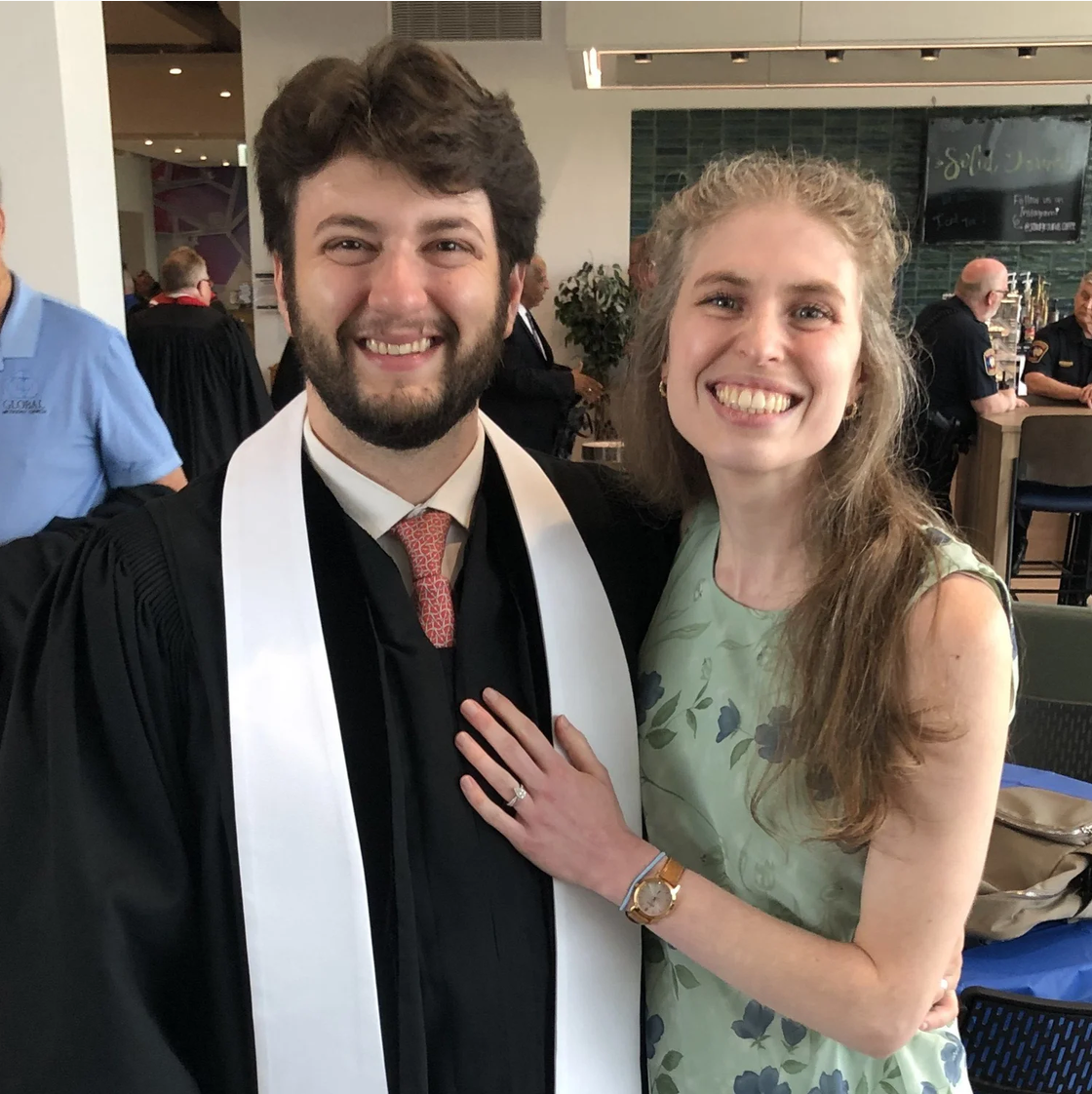
Rev. Pete Mace (pictured with wife Erica) is the current pastor of Grace Methodist Church in Ruston and a former ACF Ministry Intern. A faithful friend, brother, and servant of Christ, he is currently pursuing a Master of Divinity degree from Duke Divinity School. He is a dedicated disciple of Jesus and remains close to the hearts of those in our community. We are so grateful for his devotion to the Church!